
A Different Market: How HERS Raters Influence 30% of Residential New Construction
For building product manufacturers selling into residential construction, understanding who buys your products is important. Just as important is understanding who influences those buying decisions. That distinction matters in the HERS rated segment of new home construction. It represents a significant portion of the residential market, yet many manufacturers approach it the same way they approach the rest of new construction.
The HERS Market Continues to Grow
The number of homes receiving a HERS rating increased from 293,012 in 2020 to 412,988 in 2025, an increase of 41 percent. HERS ratings reached a high of 433,003 homes in 2024.
This growth is especially important because it has outpaced single family housing starts. Single family starts have been relatively flat since 2020, while the number of HERS rated homes has grown significantly.
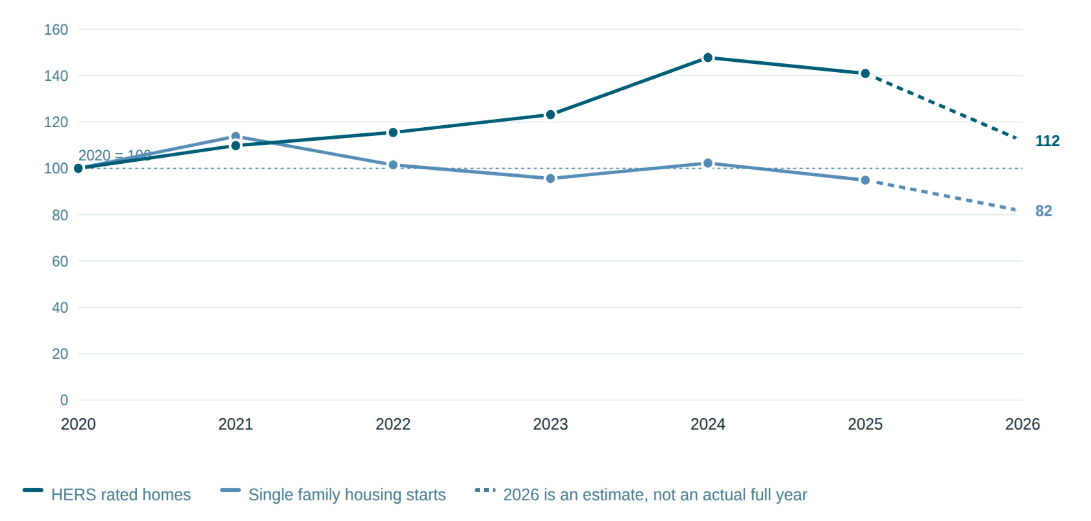
HERS rated homes vs. single family housing starts, indexed to 2020 = 100. Dashed 2026 values are estimates, not completed full year results. Housing start comparisons use U.S. Census Bureau New Residential Construction data compiled by NAHB.
In 2025, the United States had roughly 1.36 million single family and multifamily housing starts. More than 412,000 homes received a HERS rating, representing roughly 30 percent of the total.
This is not a small market segment. It represents a meaningful share of the new housing market for manufacturers of products related to a home’s energy performance. It also has a different product decision process than the rest of the residential market.
A $20 Billion Annual Product Market
Roughly 30 percent of the U.S. new housing market includes a key product influencer that many manufacturers of energy related residential building products leave out of their sales and marketing strategy: the HERS Energy Rater.
The product opportunity is substantial. HVAC equipment, including ERVs and HRVs, windows and doors, insulation, lighting fixtures and appliances installed in HERS rated homes represent more than $20 billion a year. The products are still purchased through the manufacturer’s normal channels, but the rater’s energy model can influence which products the builder ultimately chooses.
Two Different Decision Processes
Outside the HERS market, building product manufacturers generally focus their sales and marketing efforts on three groups:
Builders
Subcontractors
Distributors
The distributor often serves as the sales hub, supplying products to builders and subcontractors and helping manufacturers reach the local market.
Those same groups are present in the HERS market, but there is another important participant: the HERS Energy Rater.
The builder hires a HERS Rater to model the home’s energy performance and help determine which products and systems will meet the project’s HERS, ENERGY STAR and other performance requirements.
The builder, subcontractor and distributor remain involved in the final purchase and installation. However, the rater’s modeling and recommendations can narrow the product choices well before an order is placed.
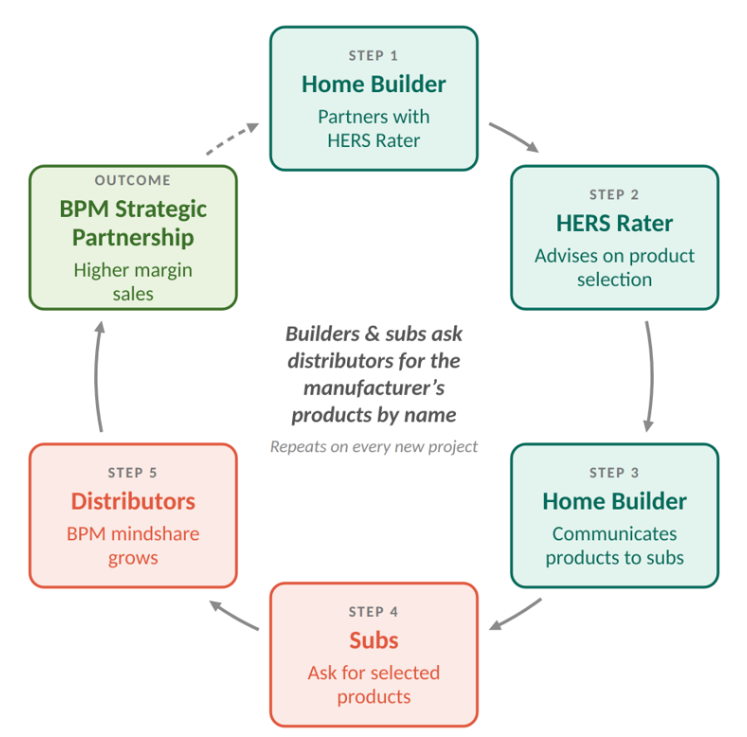
In the HERS rated segment, roughly 30 percent of U.S. housing starts, product selection often starts with HERS Rater modeling and advising, and carries through the builder, subs and distributors.
An Important Product Influencer
HERS Raters do not purchase products, and they may not appear in a manufacturer’s traditional sales plan. Even so, they can have considerable influence over which products are considered for a project. In a recent survey, Ekotrope found that 74% of the surveyed raters engage with their builders to help make spec decisions often or all the time, and 65% would share product information proactively at every opportunity or in many situations.
If a manufacturer focuses only on builders, subcontractors and distributors, it may be overlooking someone who becomes involved much earlier in the product decision process.
That is why the HERS market requires a different approach. Manufacturers need to understand the rater’s role, how products are evaluated in the energy model and what information raters need when comparing product options.
A Separate Market Strategy
The HERS market should not be treated as simply another part of the traditional residential construction market. The participants may be similar, but the decision process is different.
Manufacturers that understand this distinction can develop a more complete strategy. They can continue supporting builders, subcontractors and distributors while also investing in education and awareness for HERS Raters, and making sure their products and product information are available to HERS Raters when modeling decisions are being made.
Ekotrope can help manufacturers better understand and access this channel. Market Intelligence shows what is being modeled and where opportunities may exist. Product Listing places manufacturer products in front of HERS Raters as they evaluate options for new homes.
For manufacturers of products related to energy performance, the HERS market is a different market with different decision mechanics and should be measured and approached accordingly.
For deeper support in understanding and accessing this channel, please contact Ekotrope for a free consultation.