
What Is "REScheck" — and Why More Professionals Are Moving Beyond It
What Is "REScheck"? And Why More Professionals Are Moving Beyond It
If you've spent any time in residential energy compliance, you've almost certainly heard of REScheck. But there's a good chance you're using that name to describe something broader than the software itself.
REScheck is a free web application developed by the U.S. Department of Energy to help verify that new homes meet the Total UA Alternative pathway (R402.1.5 or R402.1.4 depending on the code year) of the energy efficiency requirements of the International Energy Conservation Code (IECC). It does this by calculating the Total UA (thermal transmittance) or Total Thermal Conductance (TC) of a building's envelope and comparing that value to a code-defined reference standard. If your proposed design performs as well or better than the reference design, the building complies.
Over time, "REScheck" has become a shorthand term in the industry — much like "Kleenex" for tissues — for the Total UA / Total TC compliance pathway itself, regardless of which software is used to calculate it. When a builder or code officials says "I need a REScheck," they typically mean they need an envelope tradeoff compliance report, not necessarily that they need to use the DOE's specific tool.
That distinction matters more today than it ever has.
How the Total UA / Total TC Pathway Works
The Total UA approach is one of several compliance pathways available under the IECC for residential construction. It works like this:
Enter building and location details. This includes the project's climate zone, building dimensions, and envelope components: insulation levels, window specifications, door U-factors, wall assemblies, floors, and roof.
Calculate compliance. The software calculates the aggregate thermal performance of your building's envelope and compares it against the IECC reference design for that climate zone. If your proposed design meets or beats the reference, the building complies.
Generate and submit the report. The compliance report is submitted to the authority having jurisdiction (AHJ) as part of the building permit process.
The pathway is popular because it offers flexibility. Builders and designers can make tradeoffs between components — a higher-performing roof assembly, for example, can offset a window package that would otherwise fall short — as long as the overall envelope performance meets code.
Read a thorough description of the Total UA math here.
The Limits of REScheck as a Tool
REScheck has served the industry for years, but it has real limitations that practitioners run into regularly.
It primarily supports the standard IECC versions with limited support for state-specific code adoptions. Which means you might be out of luck if it doesn’t support your locally amended energy code. It doesn't help you understand why a design is failing, or what changes would bring it into compliance most efficiently. And as states adopt newer code cycles or modify the IECC with their own amendments, REScheck often lags behind — or doesn't cover those requirements at all.
For anyone doing this work at volume, those gaps add up.
Ekotrope CODE: Built for the Full Picture
Ekotrope CODE is designed to handle what REScheck can't.
Ekotrope CODE supports multiple energy codes and state-specific adoptions, giving you compliance coverage across jurisdictions without switching tools. Whether you're working on a project in a state running IECC 2018, one that has adopted 2021, or a jurisdiction with custom amendments, Ekotrope CODE is built to keep pace with the actual regulatory landscape.
Ekotrope CODE also goes beyond simply telling you whether a project passes or fails. The Tradeoff Explorer gives practitioners an interactive way to understand how design choices affect compliance, visualizing how changes to one component ripple through the envelope calculation. Instead of iterating blindly through input changes, you can see which tradeoffs are worth making and make faster, more informed decisions for your clients.
For professionals who have been using REScheck as their go-to tool for Total UA / Total TC compliance, Ekotrope CODE offers a path to a more complete workflow without abandoning the compliance approach you already know.
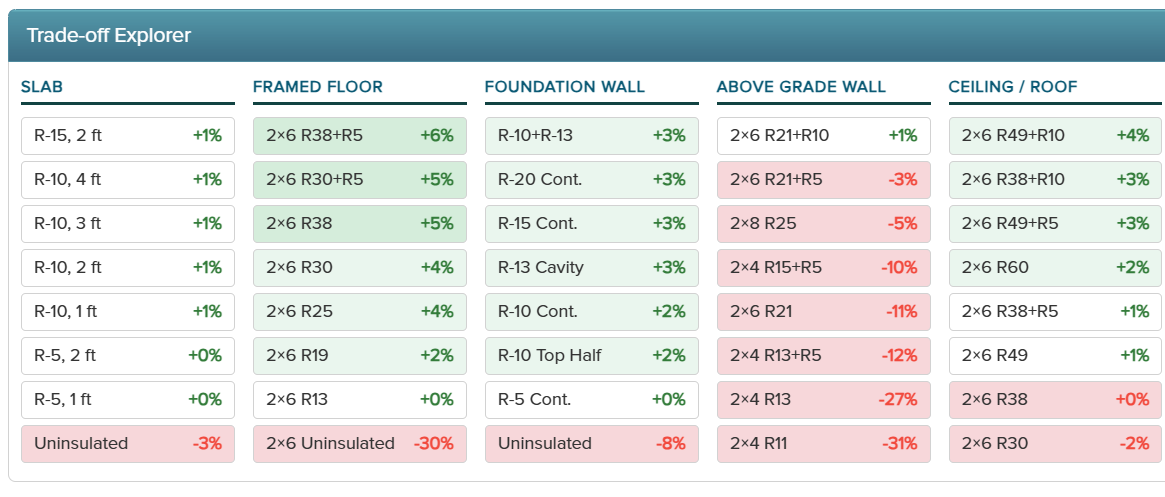
Ekotrope Code’s Tradeoff Explorer shows you all specification tradeoffs to get your home to pass energy code.
Who Uses Ekotrope CODE
Ekotrope CODE is used by architects, energy consultants, builders, and code officials who need reliable envelope compliance documentation. It's particularly well-suited for professionals who:
Work across multiple states or jurisdictions with different code requirements
Need to generate Total UA / TC compliance reports alongside other energy compliance work
Want to spend less time troubleshooting failing designs and more time moving projects forward
Are looking for a tool that will stay current as state code adoption continues to evolve
Getting Started
Ekotrope CODE is available at www.ekotrope.com/ekotrope-code. If you're currently using REScheck for Total UA or Total TC compliance, or if you've simply been doing what the industry calls "running a REScheck," it's worth taking a look at what a purpose-built alternative can do for your workflow.
